How to Make a Good Profile on New Renaissance
Your profile is an introduction to a person and a practice. Build one that makes your work understandable and the next conversation easier to begin.
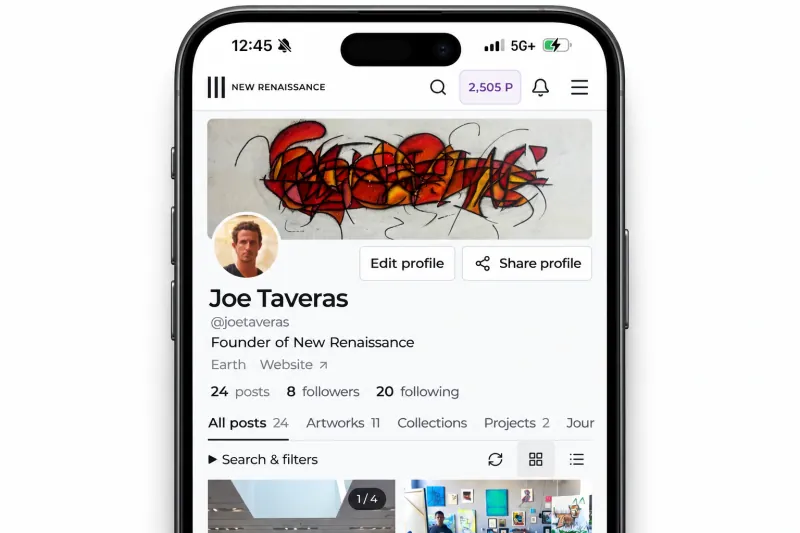
A good New Renaissance profile answers four questions: who are you, what occupies your attention, what can someone learn from your work, and how might they connect with you? The strongest profiles make those answers easy to find. They give another person enough context to approach you with curiosity and purpose.
An artist’s profile can hold a practice as it develops. A collector’s can describe the interests behind a collection. A curator’s can connect research with projects and invitations. An institution’s can make a programme understandable to the people it hopes to reach. In every case, the profile is a small act of hospitality: you are preparing an entrance to your world.
Begin with a recognizable identity
Open your profile and choose Edit profile, or go to Profile & settings. Use a display name that people who know your work would recognize. A professional name is appropriate when it is the name under which you actually practice. Keep your username easy to read and reasonably consistent with the identity you use elsewhere.
New Renaissance currently allows a username change once every seven days. Choose deliberately and check spelling before saving. Your display name, username and headline have different jobs: the name identifies you, the username gives people a reliable way to refer to you, and the headline explains the perspective you bring.
For an organization, make the account’s relationship to the organization clear. Use its recognized name and official website, and describe the programme or team represented. A visitor should not have to infer whether they are reading an artist’s independent view, a gallery’s announcement or an institution’s official account.
Let the portrait and cover do different work
A profile image is read at small sizes, often beside a comment or message. Choose an image that remains recognizable when reduced. For an individual, a clear portrait usually makes that task easier. For an institution, a simple established mark may be more useful. Check the crop: an expressive image loses its purpose if the face or identifying detail disappears.
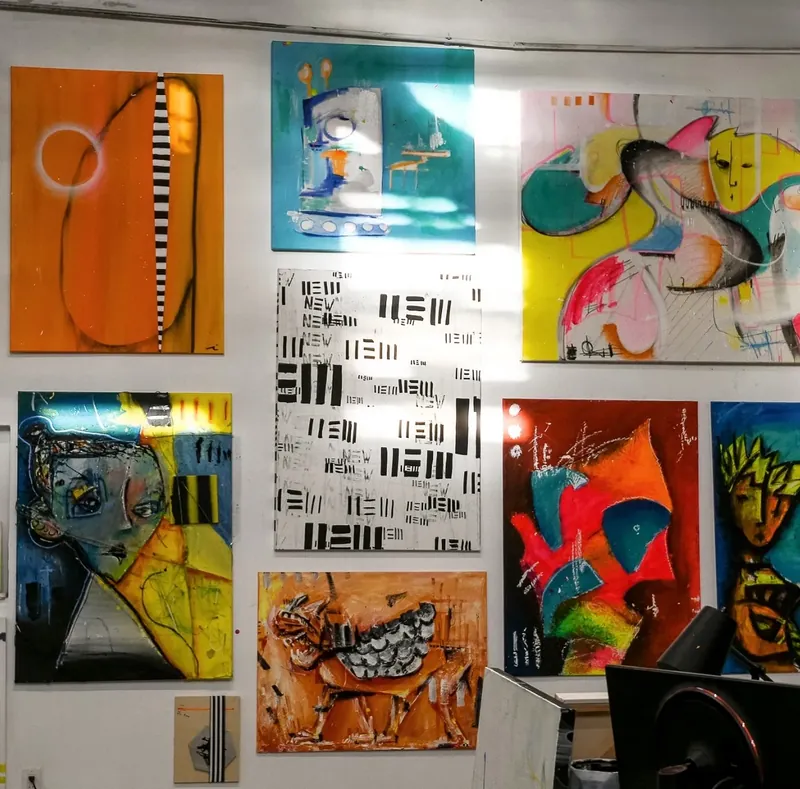
The cover has more room to convey a setting, material or body of work. A painting, installation view or studio photograph can introduce something the biography will develop. Choose an image you are entitled to share, and consider how its central subject survives both a wide desktop crop and a narrow mobile view. Text embedded in a cover is often difficult to read on a phone.
A portrait establishes recognition; a cover gives context. Their relationship should feel considered. An institution might pair its logo with a programme photograph. A ceramic artist might use a portrait beside a close view of a glazed surface. A collector could choose a meaningful installation view while keeping private addresses and personal records out of the frame.
Write a headline that says something concrete
The Profile headline field is a short introduction, with room for up to 160 characters. Start with your practice or role, then add a meaningful focus. The purpose is to help someone decide where to begin looking. A statement that could describe almost anyone gives the reader very little to work with.
Compare a broad claim such as “Creative visionary exploring limitless possibilities” with a more informative line: “Painter working with urban memory, layered color and found images.” The second gives the reader a medium, a subject and a way to approach the work. Its usefulness comes from information, not from a claim to importance.
- Artist example: “Sculptor exploring repair through reclaimed wood and hand-built forms.”
- Collector example: “Collector researching contemporary photography and the changing life of cities.”
- Curator example: “Independent curator developing exhibitions on craft, migration and material memory.”
- Institution example: “A cultural programme bringing artists into conversation with science and public learning.”
These are invented examples of structure. Replace them with words that describe your actual practice; do not adopt a field, credential or affiliation because it sounds persuasive.
Give the biography a clear sequence
The About you field allows up to 2,000 characters. It is room for a useful introduction, not an obligation to fill the available space. Begin with what you do. Explain the materials, questions or interests that organize it. Add one or two relevant facts that help a reader understand your experience. End with a current direction or a specific invitation to connect.
The School of the Art Institute of Chicago’s guidance on artist statements asks writers to articulate their ideas, process and intentions in specific language. Applied to a New Renaissance profile, that advice suggests giving a visitor an entry point into the work before presenting a list of accomplishments. A biography can establish context; a short account of practice explains what a person will encounter.
Consider this fictional example: “I am a photographer based in Lisbon, working on how coastal cities change through tourism and migration. My current series pairs harbor photographs with conversations recorded during repeated walks. I am interested in exchanging methods with documentary artists and meeting curators developing projects on urban life.” The introduction names a place, a method, a question and a reason to connect.
A collector can write with the same specificity without presenting as an artist: “I am building a collection around contemporary drawing and the uses of paper. I am particularly interested in how artists record revision, doubt and repetition. I am here to follow practices over time and learn from conversations about materials and conservation.” The value lies in the clarity of the interest.
Keep achievements proportionate and verifiable. Name a selected exhibition or collaboration when it helps the reader understand the practice. Distinguish participation from representation, a purchase from a commission, and a proposed project from a completed one. Accuracy makes an introduction more durable as relationships deepen.
Tell people what you offer and what you are seeking
New Renaissance includes separate fields for What I can help with and What you are looking for. Use them to make the next conversation easier. Offering describes a contribution: curatorial research, fabrication experience, a particular practice, collection knowledge or another area of expertise. Looking for describes a present need or interest.
A project needs more context than “open to opportunities.” You might be seeking a collaborator with sound experience for an installation, an exhibition space for a completed photographic series, or a conversation with collectors interested in a particular medium. State the scope you know. Leave uncertain details open for discussion instead of manufacturing a finished brief.
In The Social Machine, Judith Donath examines how online environments convey identity, action and social context. Her work helps explain why the details of a profile matter. Our editorial application is simple: a specific introduction gives a reader evidence to interpret, while a generic claim leaves them guessing. A profile should help people form reasonable expectations of an exchange.
Make the work support the introduction
Add a considered selection of work and make each entry understandable on its own. For artworks, provide the title, date, materials and dimensions where applicable. For projects, explain the purpose, current stage and next step. Journal entries can show how you think about a process, an encounter or a recurring question.
Begin with enough material to establish a direction. Three carefully explained works can give a visitor a stronger introduction than a long sequence of unlabeled images. That is an editorial starting point, not a platform rule. A varied practice may need more examples; a single project may benefit from deeper documentation. Select according to what the reader needs to understand.
Keep related contributions connected. If your biography describes a research project, make that project easy to locate in your published work. If a journal reflects on a particular artwork, identify it clearly. Consistent names and dates help someone move between the different parts of your practice. Read Posting on New Renaissance for a detailed approach to these entries.
Use interests, location and links deliberately
Add a location at the level you are comfortable sharing, such as a city and country. A cultural relationship often has a practical geography: a studio visit, an installation or a local event. You can make that context useful without publishing a home address. Link to a current website that adds relevant information, and check that the address opens correctly.
The Interests field accepts up to ten interests, separated by commas. Choose terms that describe what you actually want to encounter. A few precise interests offer more direction than an attempt to cover every creative discipline. Use familiar language in the headline and biography as well. Searchability begins with an accurate description of what is there.
Decide who the profile is for
In Profile visibility, Members only limits the profile to the signed-in community. Choosing a public profile allows people to read it without an account and may make it discoverable in Google. This is a deliberate choice, not a prerequisite for participating. Your individual posts and artworks keep their own audience settings.
A Private account requires approval for new followers. Existing followers retain access unless you remove them, and basic identity information remains discoverable to members. Review the explanation beside the control before saving. Incoming messages can also be turned on or off. These choices should fit the kind of participation you want.
If public discovery is your aim, use a consistent name, an informative headline, original descriptions and a relevant website link. Then publish selected work to the public audience where that option is available. Visibility makes a page eligible to be found; it does not guarantee indexing or a particular search position.
Read it as a stranger would
After saving, return to your profile on a phone and a larger screen if available. Check the image crop, read the first lines without expanding anything and open the website link. Ask whether your introduction accurately matches the work below it. Correct outdated opportunities and affiliations. A profile becomes more trustworthy when it reflects the practice as it exists now.
For a useful final check, ask someone unfamiliar with your work to describe it after reading the page. Where their understanding differs from your intention, improve the description or the selection. The objective is not to remove every ambiguity from art. It is to make the introduction clear enough that a person can begin looking with attention.
Continue with How to Use New Renaissance for the wider platform, or read The New Renaissance Story for the thinking behind it.
Sources and further reading
- School of the Art Institute of Chicago, “Artist & Teaching Statements.”
- Judith Donath, The Social Machine: Designs for Living Online (MIT Press, 2014). Publisher overview.
Profile fields and visibility controls reviewed 15 October 2026. Examples are fictional; the recommendations about selection and writing are editorial guidance rather than platform requirements.
 Using New Renaissance · 8 min read
 Using New Renaissance · 9 min read