The New Renaissance Story: From Art Advisory to Cultural Network
An artist’s question became an advisory, a series of encounters and a platform. The thread connecting them is the relationship between creative work and the people who sustain it.
An artwork begins with someone making a decision. Its life quickly involves other people: the person who looks closely, the collector who lives with it, the curator who places it in a conversation, the institution that gives it a setting. New Renaissance grew from an interest in those relationships and in the possibilities that emerge when they are given care.
The company’s story begins with Joe Taveras’s decision to establish New Renaissance Art Advisory in December 2022. It develops through his creative practice, Jess Mouawad’s role as Founding Strategic Partner, encounters around art and a temporary showroom in Malta. Today, the platform at newrenaissance.global gives that work an everyday setting where people can share, discover and communicate across distance.
The founding question
In his published account of the founding, Taveras locates the decision on a walk through Miami in December 2022. He wanted to create an advisory that could introduce visionary artists while providing a means for cultural patronage. The idea arose from his own experience making art and developing relationships with people who collected and supported it.
That distinction explains the direction of the company. A practice can produce compelling work and still need introductions, practical knowledge, resources and sustained attention. An acquisition can matter to an artist’s livelihood while also becoming the beginning of a collector’s education. The relationships surrounding a work shape the circumstances in which it can be seen, understood and sustained.
Taveras’s background spans technology and creative work, including robotics and painting. For New Renaissance, the relevant connection is a concern with how things are made and how people participate in them. The company gave that concern an organizational form. Its founding question was how an artist’s experience could become a structure that also served the work of others.
An advisory built around the life of the work
Art advisory begins with particular people and particular decisions. A collector may be learning how to look, developing an existing collection or considering a commission. An organization may want a cultural programme that belongs to its setting. An artist may need a conversation with someone able to understand the work and act on that understanding.
Those situations call for research, judgment and clear communication. The work has to be understood in relation to the person, place and purpose involved. A painting in a private home has one context; a commission for a public-facing institution has another. The responsibilities surrounding selection, presentation and continued care need attention alongside the initial encounter.
New Renaissance’s advisory practice developed around these relationships, connecting collecting, commissions, partnerships and patronage. Its wider cultural ambition follows from the same premise: people need ways to participate that are meaningful to them and useful to the work they support. A conversation becomes valuable when the parties understand what they can contribute and what they are undertaking.
Joe Taveras and Jess Mouawad: a shared direction
Joe Taveras is New Renaissance’s Founder and CEO. Jess Mouawad is its Founding Strategic Partner and the Founder and CEO of JM Vision Strategy. Her international work spans business, culture, entertainment, luxury and the creative industries. At New Renaissance, she brings that strategic perspective and those relationships to the company’s development.
The distinction between their roles matters, as does the fact of their shared work. Taveras’s proximity to artistic practice and Mouawad’s experience across organizations and cultural contexts meet in the task of building the company. New Renaissance’s public history includes both people bringing its ideas into conversation with artists, collectors and institutions.
A cultural ambition needs this meeting of perspectives. The work itself has questions and demands. Partners have resources, constraints and responsibilities. People approach an encounter with different kinds of knowledge. Connecting those perspectives requires listening closely enough that a shared purpose can emerge without losing what each participant contributes.
Malta made the idea tangible
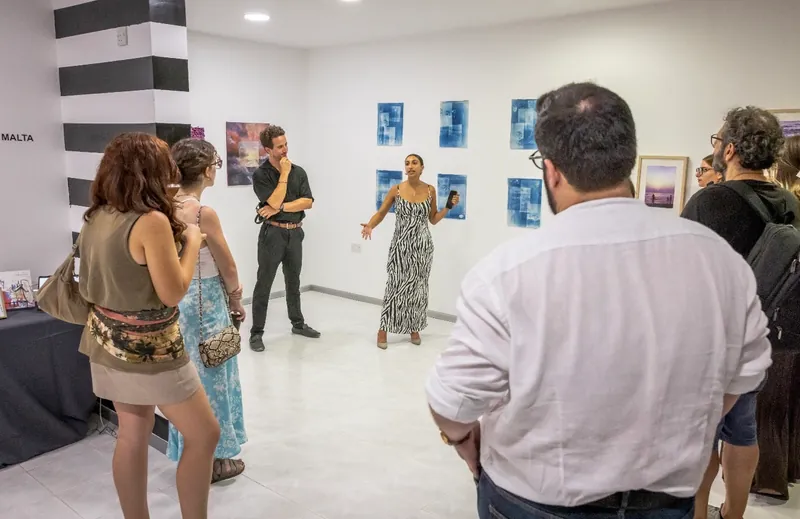
In August 2026, New Renaissance opened a temporary showroom in Tarxien, Malta. The presentation brought together work by Matthew Joseph Casha, Naomi Smith, Marina Po and Joe Taveras. On 14 August, the first private salon gathered guests in the space, with remarks from Taveras and Mouawad and direct encounters with the artists and their work. MaltaToday documented the opening on 19 August.
The showroom was a time-limited physical expression of the company’s approach. Its significance lies in what it allowed people to do together: spend time with works, hear from their makers and begin conversations in a shared setting. The photographs preserve a particular occasion in New Renaissance’s development. They are a record of that presentation, rather than an announcement of a permanently operating venue.
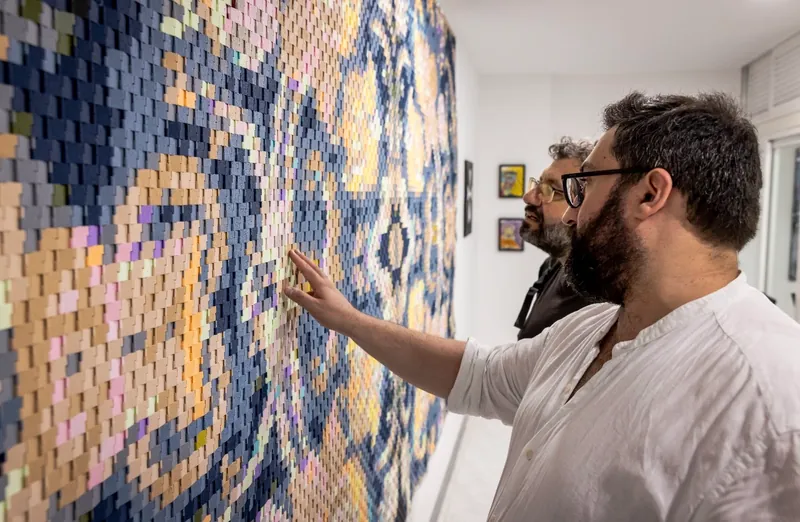
The images make the value of proximity visible. People can compare a detail with the whole work, understand scale through the room and return to an object after hearing someone speak. The encounter has a duration that a passing image often lacks. A gathering can make space for the question a person might not think to ask while looking alone.
Malta also gives this chapter a specific human context: Mouawad was born on the island. The presentation participated in a local creative environment while connecting it with New Renaissance’s international outlook. Its importance does not require a claim to have transformed that environment. It provided an actual occasion where the company’s idea could be experienced and discussed.
The Malta archive remains part of the story. A temporary presentation can have a continuing value as documentation, a reference for future work and a record of relationships begun. Any future initiative must respond to the conditions of its own place, participants and purpose.
Why relationships belong at the center
The sociologist Howard S. Becker’s Art Worlds examines art as collective activity, involving the cooperative relationships through which work is made, distributed and understood. This framework offers useful context for New Renaissance’s interests. It directs attention to the people and arrangements around creative practice, as well as to the artist’s individual decisions.
That is an intellectual reference, not an endorsement of the company or evidence of its impact. Our interpretation is that a cultural platform should make those relationships easier to recognize and develop. The person making work, the person supporting it and the organization presenting it have different responsibilities, but they can still participate in a shared conversation.
An artist may need time and resources. A collector may need context before making a decision. An institution may need to understand how a project relates to its public purpose. When each can explain their interests clearly, collaboration has a firmer basis. This is one reason New Renaissance treats profiles, projects and conversation as connected parts of the experience.
From occasional encounters to everyday participation
A salon brings people together for a particular occasion. An online platform allows contact to continue between occasions and across places. The two forms have different strengths. A physical encounter gives access to material and shared presence; an online contribution can make an idea available to someone who could not enter the room.
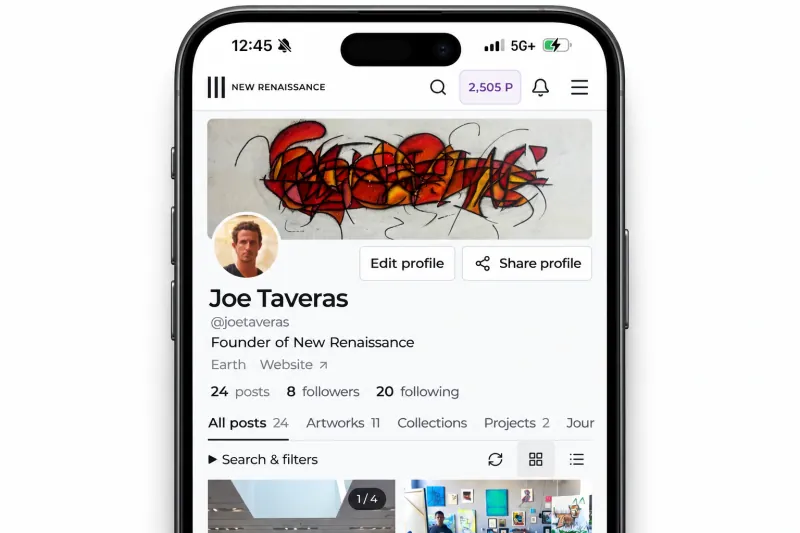
New Renaissance now brings profiles, artworks, posts, projects, collections, opportunities and journal writing into a social network. Members can follow practices, respond to work and begin conversations. An artist can explain how a piece developed. A curator can introduce a question. A collector can articulate an interest. A cultural organization can describe an invitation to participate.
The platform gives the broader ambition a practical form. A profile supplies an introduction; a work provides something to discuss; a project states what is underway; a message begins an exchange. Purple, the platform’s credit system, recognizes eligible participation and supports certain interactions. Its purpose sits within the larger activity of the community.
The quality of that activity is an ongoing responsibility. A platform cannot declare that meaningful relationships exist simply because accounts have been created. It has to make participation understandable, preserve members’ choices and give people reasons to return. The company’s ambition should be judged through the usefulness of what members can do and the care with which it is maintained.
How the platform, advisory and Journal connect
The network offers a place for participation. The advisory provides personal guidance around collecting, commissions and cultural projects. The Journal develops ideas and records encounters in a form that can be read and revisited. In-person initiatives create occasions for direct engagement. Each serves a different part of cultural life while sharing an interest in the relationships around creative work.
Joining the platform is a way to take part in the community. Advisory work and formal collaborations require their own conversations, scope and agreements. That clarity matters: discovering an artist, following a practice and commissioning a work are different steps, each with its own expectations.
The name New Renaissance expresses an aspiration to renewal through creative participation. The history so far is more particular: a founding decision, an advisory practice, shared work, a temporary showroom and a developing platform. Keeping the aspiration connected to those concrete events gives the story its substance and leaves room for the next chapter to be earned.
Where the story meets the reader
A cultural network takes its shape from the people who enter it and what they choose to contribute. You might arrive with a finished body of work, a question about collecting, an exhibition idea or a curiosity you cannot yet name. Begin by making that interest visible, then give someone else’s contribution the attention you hope your own will receive.
For a practical introduction, read How to Use New Renaissance, How to Make a Good Profile and Posting on New Renaissance. Membership is currently referral-based, with a public waitlist for people who would like to join. For collecting, commissions or cultural projects, begin a conversation with the advisory.
Sources and further reading
- Joe Taveras, “New Renaissance Art Advisory: Founding Story” (29 July 2025).
- MaltaToday, “New Renaissance opens its first showroom, creating a new space for art, dialogue and connection” (19 August 2026).
- Howard S. Becker, Art Worlds, 25th Anniversary Edition (University of California Press, 2008). Publisher overview.
This account draws on the founder’s published history, New Renaissance’s archive and company information, and contemporaneous coverage of the Malta presentation. The temporary nature of the showroom is reflected in the current account. The interpretation of the company’s direction is New Renaissance’s own. Published 15 October 2026.
 Using New Renaissance · 8 min read
 Using New Renaissance · 9 min read